This change adds a feature to `UndoHistory` that allows the user to modify the value being pushed onto the undo stack.
This is used by the framework to ignore the composing region when pushing history entries to the Undo stack on Android. This is so an undo does not trigger an input connection restart by the Android TextInputPlugin, which occurs when the framework changes the composing region. This is also the native platform behavior observed in Google Keep app on Android, where doing an undo during composing reverts to the previous state but with composing inactive and a subsequent redo does not bring back the composing region.
Fixes#130881
Partial fix for #134398
Fixes#11884
As #38926 pointed out, the current Flutter implementation of multi-finger drag behavior is different from iOS and Android.
This change introduces the `MultitouchDragStrategy` attribute, which implements the Android behavior and can be controlled through `ScrollBehavior`, while retaining the ability to extend iOS behavior in the future.
Towards https://github.com/flutter/flutter/issues/134501.

This change is based on https://github.com/flutter/engine/pull/48090. It changes the `RenderView` to be dynamically sized based on its content if the `FlutterView` it is configured with allows it (i.e. the `FlutterView` has loose `FlutterView.physicalConstraints`). For that, it uses those `physicalConstraints` as input to the layout algorithm by passing them on to its child (after translating them to logical constraints via the device pixel ratio). The resulting `Size` that the `RenderView` would like to be is then communicated back to the engine by passing it to the `FlutterView.render` call.

Tests will fail until https://github.com/flutter/engine/pull/48090 has rolled into the framework.
Provide a parameter `applyTextScaling` to both `Icon` and `IconDataTheme`. When `true`, the context's `TextScaler` will apply it's `scale` method to the icon size.
Fixes#115466
**What has been done?**
----------------------
Added new enumeration in `TableCellVerticalAlignment`, which sets the cell size to the same as the topmost cell. There are no noticeable problems in using it in all cells together, as there are in `TableCellVerticalAlignment.fill` which is made not to be used in all cells together because it has another purpose.
**Explanation of the logic**
----------------------
An assignment was made (which already existed in `TableCellVerticalAlignment.top; middle and bottom`) that assigns `rowHeight` the maximum double between the initialized height and the height of its child.

Basically, defining a minimum cell height based on its child, and letting each table row have its own height stipulated from the largest element, creating an `IntrinsicHeight` for TableCell automatically.

As the `TableCellVerticalAlignment` logic already provides for the use of the height of the largest cell in the row, it was possible to reuse this logic, and just not make the break statement that exists to fill in the calculation for `intrinsicHeight`.
Real example in an Android application after added enumeration
----------------------
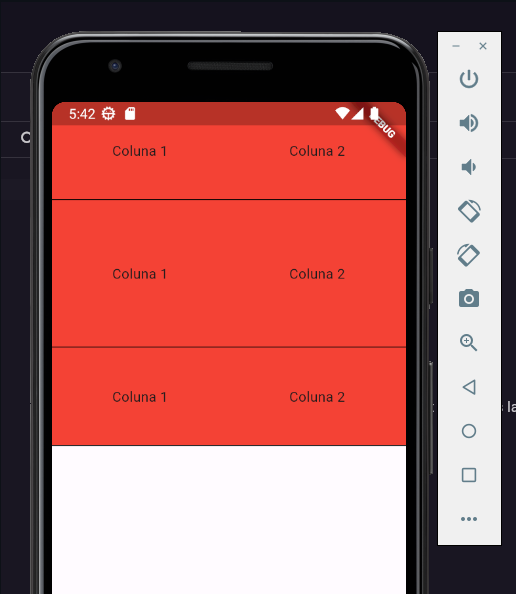
Opened issue
----------------------
FIX: #130261
Fixes https://github.com/flutter/flutter/issues/138592.

In an `Icon` widget if the icon font's body (ascender + descender) is larger than the font's units per em, the icon height reported by the text layout library will be larger than the specified font size. When that happens the icon glyph gets pushed towards the bottom because the `Icon` widget is wrapped in a fontSize x fontSize SizedBox and thus has a fixed height of fontSize px. This wasn't a problem for material icons because its UPEM == body.
`FakeView` wraps the same underlying `FlutterView`. Sending semantics updates and Scene objects from multiple fake views into the same engine `FlutterView` violates contracts with the engine. This PR stubs out `render` and `updateSemantics` methods in `FakeView` classes to prevent that.

This unblocks https://github.com/flutter/engine/pull/48251, which implements multi-view semantics for web.
This version is needed so that dart:js_interop can move to extension
types. Also adds some code to handle some breaking changes:

- Body -> Response. Body was an IDL interface mixin type we exposed in
dart:html. Going forward, users should either use Request or Response.
- Casts to JSAny. These are temporary until we move package:web types to
extension types. Currently, package:web types can't implement JSObject
as JSObject will move to be an extension type itself.

Co-authored-by: Kevin Moore <kevmoo@users.noreply.github.com>
Adopted from https://github.com/flutter/flutter/pull/133750
That PR was abandoned. This finishes it up so we can land it.
Fixes https://github.com/flutter/flutter/issues/133529

Moves the `PanGestureRecognizer` used to drag the content along both axis to the outer vertical `Scrollable` subclass instead of the inner horizontal `Scrollable` subclass.

- This solves the issue of the inner `Scrollable` gestures being disabled while the outer `Scrollable` is scrolling
- Enables the user to stop the scroll movement by dragging the content again
Added "color" and "colorBlendMode" props in [FadeInImage](https://api.flutter.dev/flutter/widgets/FadeInImage-class.html) and applied it to both placeholder and the target image.

Added test to check weather both properties are applied to placeholder and the target image.

Fixes  https://github.com/flutter/flutter/issues/128229

Migration is not required because I have added two optional props and have not updated any existing code. Devs may choose to use them if they have a usecase. Existing projects should not get affected.(no errors or warning)
Call the `dependency.removeDependent(this)` instead of `dependency._dependents.remove(this)` inside the `Element.deactivate()`. This allows `InheritedElements` to know when they can release resources associated with a given dependent `Element`.
Fixes#129207
Background: In the framework, the position of the caret rect is updated on each cursor position change such that if the user initiates composing input, the current cursor position can be used for the first character until the composing rect can be sent.

Previously, no update was sent on selection changes, on the assumption that the most recent cursor position will remain the correct position for the duration of the selection. While this is the case for forward selections, it is an incorrect assumption for reversed selections, where selection.base > selection.extent.

We now update the cursor position during selection changes such that the cursor position sent to the embedder is always the position at which next text input would occur. This is the start position of the selection or min(selection.baseOffset, selection.extentOffset).

Issue: https://github.com/flutter/flutter/issues/137677
Makes the `data` parameter of `Draggable` non-nullable.

Fixes https://github.com/flutter/flutter/issues/84816

*If you had to change anything in the [flutter/tests] repo, include a link to the migration guide as per the [breaking change policy].*
Reverts flutter/flutter#137550
Initiated by: Piinks
This change reverts the following previous change:
Original Description:
This PR removes `ButtonBar` usage from `framework_test.dart` class and update other references in preparation for `ButtonBar` deprecation

related to https://github.com/flutter/flutter/issues/127955
This PR removes `ButtonBar` usage from `framework_test.dart` class and update other references in preparation for `ButtonBar` deprecation

related to https://github.com/flutter/flutter/issues/127955
This method controls whether the builder needs to be called again again even if the layout constraints are the same.

By default, the builder will always be called when the widget is updated because the logic in the callback might have changed. However, there are cases where subclasses of ConstrainedLayoutBuilder know that certain property updates only affect paint and not build. In these cases, we lack a way of expressing that the builder callback is not needed -- and we end up doing superfluous work.

This PR gives subclasses the ability to know exactly when the callback needs to be called and when it can be skipped.
Reverts flutter/flutter#136771
Initiated by: gspencergoog
This change reverts the following previous change:
Original Description:
## Description

This adds code to make sure that grandchildren are removed from the `focusedChild` of a scope when the child is detached.

## Related Issues
 - Fixes https://github.com/flutter/flutter/issues/136758

## Tests
 - Added regression test.
## Description

This adds code to make sure that grandchildren are removed from the `focusedChild` of a scope when the child is detached.

## Related Issues
 - Fixes https://github.com/flutter/flutter/issues/136758

## Tests
 - Added regression test.
### Description
- Fixes https://github.com/flutter/flutter/issues/134205.

### Tests
- Removes ignoring the `_RestorableRouteInformation` leak from `cupertino/app_test.dart`;
- Removes ignoring the `_RestorableRouteInformation` leak from `material/app_test.dart`;
- Removes ignoring the `_RestorableRouteInformation` leak from `widgets/app_test.dart`;
- Removes ignoring the `_RestorableRouteInformation` leak from `widgets/route_notification_messages_test.dart`;
- Removes ignoring the `_RestorableRouteInformation` leak from `widgets/router_restoration_test.dart`;
- Updates `widgets/router_test.dart` to use `testWidgetsWithLeakTracking`.
## Description

In order for `MenuAnchor` menus to be able to not pass on the taps that close their menus, `TapRegion` needed a way to consume them.  This change adds a flag to the `TapRegion`, `consumeOutsideTap` that will consume taps that occur outside of the region if the flag is set (it is false by default). The same flag is added to `MenuAnchor` to allow selecting the behavior for menus.

`TapRegion` consumes the tap event by registering with the gesture arena and immediately resolving the tap as accepted if any regions in a group have `consumeOutsideTap` set to true.

This PR also deprecates `MenuAnchor.anchorTapClosesMenu`, since it is a much more limited version of the same feature that only applied to the anchor itself, and even then only applied to closing the menu, not passing along the tap.  The same functionality can now be implemented by handling a tap on the anchor widget and checking to see if the menu is open before closing it.

## Related Issues
 - https://github.com/flutter/flutter/issues/135327

## Tests
 - Added tests for `TapRegion` to make sure taps are consumed properly.