Fixes https://github.com/flutter/flutter/issues/131435, https://github.com/flutter/flutter/issues/104594, https://github.com/flutter/flutter/issues/43400

Currently the method we use for text span hit testing `TextPainter.getPositionForOffset` always returns the closest `TextPosition`, even when the given offset is far away from the text.

The new TextPaintes method tells you the layout bounds `(width =  letterspacing / 2 + x_advance + letterspacing / 2, height = font ascent + font descent)` of a character, the PR changes the hit testing implementation such that a TextSpan is only considered hit if the point-down event landed in one of its character's layout bounds.

Potential issues:

In theory since the text is baseline aligned, we should use the max ascent and max descent of each character to calculate the height of the text span's hit-test region, in case some characters in the span have to fall back to a different font, but that will be slower and it typically doesn't make a huge difference.
This is a breaking change.
I want to build a widget that adds some extra functionality when the inner text overflow. So the problem occurred, I can't find an elegant way to determine if the text is overflowing.
So i expose `didExceedMaxLines` from `RenderParagraph`, I think it can make sense. Have there some advice?
Reverts flutter/flutter#139717
Initiated by: LongCatIsLooong
This change reverts the following previous change:
Original Description:
Fixes https://github.com/flutter/flutter/issues/131435, #104594, #43400
Needs https://github.com/flutter/engine/pull/48774 (to fix the web test failure).

Currently the method we use for text span hit testing `TextPainter.getPositionForOffset` always returns the closest `TextPosition`, even when the given offset is far away from the text.

The new TextPaintes method tells you the layout bounds (`width =  letterspacing / 2 + x_advance + letterspacing / 2`, `height = font ascent + font descent`) of a character, the PR changes the hit testing implementation such that a TextSpan is only considered hit if the point-down event landed in one of it's character's layout bounds.

Potential issues:

1. In theory since the text is baseline aligned, we should use the max ascent and max descent of each character to calculate the height of the text span's hit-test region, in case some characters in the span have to fall back to a different font, but that will be slower and it typically doesn't make a huge difference.

This is a breaking change. It also introduces a new finder and a new method `WidgetTester.tapOnText`: `await tester.tapOnText('string to match')` for ease of migration.
Fixes https://github.com/flutter/flutter/issues/131435, #104594, #43400
Needs https://github.com/flutter/engine/pull/48774 (to fix the web test failure).

Currently the method we use for text span hit testing `TextPainter.getPositionForOffset` always returns the closest `TextPosition`, even when the given offset is far away from the text.

The new TextPaintes method tells you the layout bounds (`width =  letterspacing / 2 + x_advance + letterspacing / 2`, `height = font ascent + font descent`) of a character, the PR changes the hit testing implementation such that a TextSpan is only considered hit if the point-down event landed in one of it's character's layout bounds.

Potential issues:

1. In theory since the text is baseline aligned, we should use the max ascent and max descent of each character to calculate the height of the text span's hit-test region, in case some characters in the span have to fall back to a different font, but that will be slower and it typically doesn't make a huge difference.

This is a breaking change. It also introduces a new finder and a new method `WidgetTester.tapOnText`: `await tester.tapOnText('string to match')` for ease of migration.
This change fixes issues with screen order comparison logic when rects are encompassed within each other. This was causing issues when trying to select text that includes inline `WidgetSpan`s inside of a `SelectionArea`.
* Adds `boundingBoxes` to `Selectable` for a more precise hit testing region.
Fixes#132821
Fixes updating selection edge by word boundary when widget spans are involved.
Fixes crash when sending select word selection event to an unselectable element.
This PR adds `String? identifier` to `Semantics` and `SemanticsProperties`. The `identifier` will be exposed on Android as `resource-id` and on iOS as `accessibilityIdentifier`.

Mainly targeted at #17988

Initial Engine PR with Android support: https://github.com/flutter/engine/pull/47961
iOS Engine PR: https://github.com/flutter/engine/pull/48858

### Migration

This change breaks the SemanticsUpdateBuilder API which is on the Framework<-->Engine border. For more details see [engine PR](https://github.com/flutter/engine/pull/47961).

Steps:
part 1: [engine] add `SemanticsUpdateBuilderNew` https://github.com/flutter/engine/pull/47961
**part 2: [flutter] use `SemanticsUpdateBuilderNew`**  <-- we are here
part 3: [engine] update `SemanticsUpdateBuilder` to be the same as `SemanticsUpdateBuilderNew`*
part 4: [flutter] use (now updated) `SemanticsUpdateBuilder` again.
part 5: [engine] remove `SemanticsBuilderNew`
Towards https://github.com/flutter/flutter/issues/134501.

This change is based on https://github.com/flutter/engine/pull/48090. It changes the `RenderView` to be dynamically sized based on its content if the `FlutterView` it is configured with allows it (i.e. the `FlutterView` has loose `FlutterView.physicalConstraints`). For that, it uses those `physicalConstraints` as input to the layout algorithm by passing them on to its child (after translating them to logical constraints via the device pixel ratio). The resulting `Size` that the `RenderView` would like to be is then communicated back to the engine by passing it to the `FlutterView.render` call.

Tests will fail until https://github.com/flutter/engine/pull/48090 has rolled into the framework.
**What has been done?**
----------------------
Added new enumeration in `TableCellVerticalAlignment`, which sets the cell size to the same as the topmost cell. There are no noticeable problems in using it in all cells together, as there are in `TableCellVerticalAlignment.fill` which is made not to be used in all cells together because it has another purpose.
**Explanation of the logic**
----------------------
An assignment was made (which already existed in `TableCellVerticalAlignment.top; middle and bottom`) that assigns `rowHeight` the maximum double between the initialized height and the height of its child.

Basically, defining a minimum cell height based on its child, and letting each table row have its own height stipulated from the largest element, creating an `IntrinsicHeight` for TableCell automatically.

As the `TableCellVerticalAlignment` logic already provides for the use of the height of the largest cell in the row, it was possible to reuse this logic, and just not make the break statement that exists to fill in the calculation for `intrinsicHeight`.
Real example in an Android application after added enumeration
----------------------
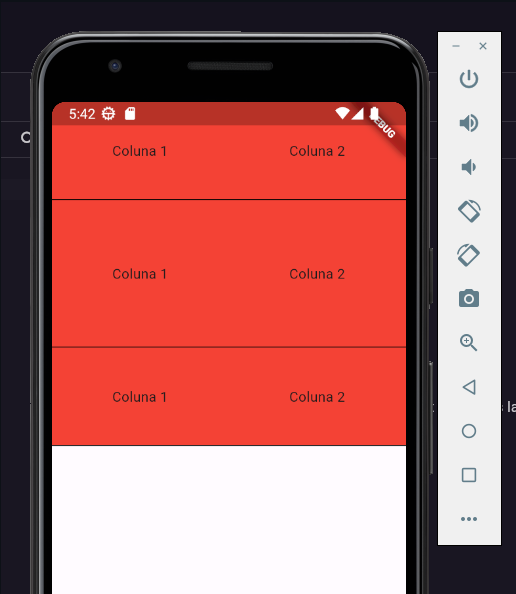
Opened issue
----------------------
FIX: #130261
*Replace this paragraph with a description of what this PR is changing or adding, and why. Consider including before/after screenshots.*

fix some typos

*List which issues are fixed by this PR. You must list at least one issue.*

*If you had to change anything in the [flutter/tests] repo, include a link to the migration guide as per the [breaking change policy].*
Before this change, long-running post-frame callbacks wouldn't show up in the timeline at all.  This adds a timeline event for post-frame callbacks, with a debug flag that will add timeline events for each individual callback.

#testexempt -- we have no way to test calls to the timeline.
## Description

This converts the `MenuAnchor` class to use `OverlayPortal` instead of directly using the overlay.

## Related Issues
 - Fixes https://github.com/flutter/flutter/issues/124830

## Tests
 - No tests yet (hence it is a draft)
Some render box subclasses have a specific layout contract that is tightly coupled with other render box subclasses (e.g. two private classes in a local project file). In these cases, it is also possible that they use a constraints object that is a subclass of `BoxConstraints`. To allow for this, this change makes the `constraints` argument to `RenderBox.computeDryLayout()` a covariant argument.

For completeness' sake, this updates the other render objects in the rendering package to also use the covariant keyword for this argument.
## Description

This updates the documentation for `MediaQuery` and `Overlay` to include the following:

- That `MediaQueryData.size` is set asynchronously, and doesn't necessarily reflect the size of the current frame.
- That the specific `MediaQuery.sizeOf` and related methods are preferred over the more generic `MediaQuery.of`.
- That the size of the `Overlay` isn't necessarily the size returned by `MediaQueryData.size`

As well as adding some symbol links, and fixing some error in documentation.

## Tests
 - Documentation only
Fixes https://github.com/flutter/flutter/issues/134656

`_skipMarkNeesLayout` was meant to only skip `markNeedsLayout` calls. Re-painting is still needed when a child gets added/removed from the `Overlay`.
This change collapses the selection at the clicked/tapped location on single click down for desktop platforms, and on single click/tap up for mobile platforms to match native.

This is a change from how `SelectionArea` previously worked. Before this change a single click down would clear the selection. From observing a native browser it looks like when tapping on static text the selection is not cleared but collapsed. A user can still attain the selection from static text using the `window.getSelection` API.

https://jsfiddle.net/juepasn3/11/ You can try this demo out here to observe this behavior yourself. When clicking on static text the selection will change.

This change also allows `Paragraph.selections` to return selections that are collapsed. This for testing purposes to confirm where the selection has been collapsed.

Partially fixes: #129583
## Description

This removes all of the comments that are of the form "so-and-so (must not be null|can ?not be null|must be non-null)" from the cases where those values are defines as non-nullable values.

This PR removes them from the animation, cupertino, foundation, gestures, semantics, and services libraries.  Each of them only had a few, so I lumped them together.

This was done by hand, since it really didn't lend itself to scripting, so it needs to be more than just spot-checked, I think. I was careful to leave any comment that referred to parameters that were nullable, but I may have missed some.

In addition to being no longer relevant after null safety has been made the default, these comments were largely fragile, in that it was easy for them to get out of date, and not be accurate anymore anyhow.

This did create a number of constructor comments which basically say "Creates a [Foo].", but I don't really know how to avoid that in a large scale change, since there's not much you can really say in a lot of cases.  I think we might consider some leniency for constructors to the "Comment must be meaningful" style guidance (which we de facto have already, since there are a bunch of these).

## Related PRs
- https://github.com/flutter/flutter/pull/134991
- https://github.com/flutter/flutter/pull/134992
- https://github.com/flutter/flutter/pull/134993
- https://github.com/flutter/flutter/pull/134994

## Tests
 - Documentation only change.
## Description

This removes all of the comments that are of the form "so-and-so (must not be null|can ?not be null|must be non-null)" from the cases where those values are defines as non-nullable values.

This PR removes them from the painting and rendering libraries.

This was done by hand, since it really didn't lend itself to scripting, so it needs to be more than just spot-checked, I think. I was careful to leave any comment that referred to parameters that were nullable, but I may have missed some.

In addition to being no longer relevant after null safety has been made the default, these comments were largely fragile, in that it was easy for them to get out of date, and not be accurate anymore anyhow.

This did create a number of constructor comments which basically say "Creates a [Foo].", but I don't really know how to avoid that in a large scale change, since there's not much you can really say in a lot of cases.  I think we might consider some leniency for constructors to the "Comment must be meaningful" style guidance (which we de facto have already, since there are a bunch of these).

## Related PRs
- https://github.com/flutter/flutter/pull/134984
- https://github.com/flutter/flutter/pull/134991
- https://github.com/flutter/flutter/pull/134992
- https://github.com/flutter/flutter/pull/134994

## Tests
 - Documentation only change.
Fixes https://github.com/flutter/flutter/issues/133545

` child._layoutSurrogate.markNeedsLayout();` was called when `_skipMarkNeedsLayout` is set true so when there's no relayout boundary between the layout surrogate and the RenderTheater, no dirty render objects will be added to the PipelineOwner's dirty list.

It's ok to mark the RenderTheater dirty when there's no layout boundary between it and the layout surrogate.

