mirror of
https://github.com/linuxserver/core.git
synced 2026-02-20 05:07:19 +08:00

63 lines
6.3 KiB
JSON
63 lines
6.3 KiB
JSON
{
|
|
"name": "rusha",
|
|
"version": "0.8.5",
|
|
"description": "A high-performance pure-javascript SHA1 implementation suitable for large binary data.",
|
|
"main": "rusha.js",
|
|
"keywords": [
|
|
"sha1",
|
|
"binary",
|
|
"crypto",
|
|
"hash"
|
|
],
|
|
"scripts": {
|
|
"test": "grunt test",
|
|
"test-saucelabs": "grunt test-saucelabs",
|
|
"build": "grunt build"
|
|
},
|
|
"repository": {
|
|
"type": "git",
|
|
"url": "git+https://github.com/srijs/rusha.git"
|
|
},
|
|
"devDependencies": {
|
|
"asm.js": "0.0.2",
|
|
"benchmark": "^1.0.0",
|
|
"blanket": "~1.1.6",
|
|
"grunt": "~0.4.5",
|
|
"grunt-browserify": "^3.5.0",
|
|
"grunt-cli": "~0.1.13",
|
|
"grunt-contrib-connect": "^0.8.0",
|
|
"grunt-contrib-uglify": "~0.5.1",
|
|
"grunt-mocha-test": "~0.11.0",
|
|
"grunt-saucelabs": "^8.3.2",
|
|
"grunt-sweet.js": "~0.1.5",
|
|
"microtime": "^2.1.1",
|
|
"mocha": "^3.0.2",
|
|
"sweet.js": "~0.7.1"
|
|
},
|
|
"testling": {
|
|
"files": "test/test.js",
|
|
"harness": "mocha-tdd",
|
|
"browsers": [
|
|
"ie/6..latest",
|
|
"chrome/22..latest",
|
|
"firefox/16..latest",
|
|
"safari/latest",
|
|
"opera/11.0..latest"
|
|
]
|
|
},
|
|
"author": {
|
|
"name": "Sam Rijs"
|
|
},
|
|
"license": "MIT",
|
|
"readmeFilename": "README.md",
|
|
"readme": "# Rusha [](https://travis-ci.org/srijs/rusha)\n*A high-performance pure-javascript SHA1 implementation suitable for large binary data.*\n\n[](https://nodei.co/npm/rusha/)\n\n## Prologue: The Sad State of Javascript SHA1 implementations\n\nWhen we started experimenting with alternative upload technologies at [doctape](http://doctape.com) that required creating SHA1 hashes of the data locally on the client, it quickly became obvious that there were no performant pure-js implementations of SHA1 that worked correctly on binary data.\n\nJeff Mott's [CryptoJS](http://code.google.com/p/crypto-js/) and Brian Turek's [jsSHA](http://caligatio.github.com/jsSHA/) were both hash functions that worked correctly on ASCII strings of a small size, but didn't scale to large data and/or didn't work correctly with binary data.\n\n(On a sidenode, as of now Tim Caswell's [Cifre](http://github.com/openpeer/cifre) actually works with large binary data, as opposed to previously statet.)\n\nBy modifying Paul Johnston's [sha1.js](http://pajhome.org.uk/crypt/md5/sha1.html) slightly, it worked correctly on binary data but was unfortunately very slow, especially on V8. So a few days were invested on my side to implement a Johnston-inspired SHA1 hashing function with a heavy focus on performance.\n\nThe result of this process is Rusha, a SHA1 hash function that works flawlessly on large amounts binary data, such as binary strings or ArrayBuffers returned by the HTML5 File API, and leverages the soon-to-be-landed-in-firefox [asm.js](http://asmjs.org/spec/latest/) with whose support its within *half of native speed*!\n\n## Installing\n\n### Node.JS\n\nThere is really no point in doing this, since Node.JS already has a wonderful `crypto` module that is leveraging low-level hardware instructions to perform really nice. Your can see the comparison below in the benchmarks.\n\nRusha is available on [npm](http://npmjs.org/) via `npm install rusha`.\n\nIf you still want to do this, anyhow, just `require()` the `rusha.js` file, follow the instructions on _Using the Rusha Object_.\n\n### Browser\n\nRusha is available on [bower](http://twitter.github.com/bower/) via `bower install rusha`.\n\nIt is highly recommended to run CPU-intensive tasks in a [Web Worker](http://developer.mozilla.org/en-US/docs/DOM/Using_web_workers). To do so, just start a worker with `var worker = new Worker('rusha.js')` and start sending it jobs. Follow the instructions on _Using the Rusha Worker_.\n\nIf you can't, for any reason, use Web Workers, include the `rusha.js` file in a `<script>` tag and follow the instructions on _Using the Rusha Object_.\n\n## Using the Rusha Object\n\nYour instantiate a new Rusha object by doing `var r = new Rusha(optionalSizeHint)`. When created, it provides the following methods:\n\n- `Rusha#digest(d)`: Create a hex digest from data of the three kinds mentioned below, or throw and error if the type is unsupported.\n- `Rusha#digestFromString(s)`: Create a hex digest from a binary `String`. A binary string is expected to only contain characters whose charCode < 256.\n- `Rusha#digestFromBuffer(b)`: Create a hex digest from a `Buffer` or `Array`. Both are expected to only contain elements < 256.\n- `Rusha#digestFromArrayBuffer(a)`: Create a hex digest from an `ArrayBuffer` object.\n- `Rusha#rawDigest(d)`: Behaves just like #digest(d), except that it returns the digest as an Int32Array of size 5.\n\n## Using the Rusha Worker\n\nYou can send your instance of the web worker messages in the format `{id: jobid, data: dataobject}`. The worker then sends back a message in the format `{id: jobid, hash: hash}`, were jobid is the id of the job previously received and hash is the hash of the data-object you passed, be it a `Blob`, `Array`, `Buffer`, `ArrayBuffer` or `String`.\n\n## Development\n\n* Download npm dependencies with `npm install`\n* Source file to be edited is `rusha.sweet.js`\n* Build with `npm run build`\n* Run tests with `npm test`\n\n## Benchmarks\n\nTested were my Rusha implementation, the sha1.js implementation by [P. A. Johnston](http://pajhome.org.uk/crypt/md5/sha1.html), Tim Caswell's [Cifre](http://github.com/openpeer/cifre) and the Node.JS native implementation.\n\nIf you want to check the performance for yourself in your own browser, I compiled a [JSPerf Page](http://jsperf.com/rusha/13).\n\nA normalized estimation based on the best results for each implementation, smaller is better:\n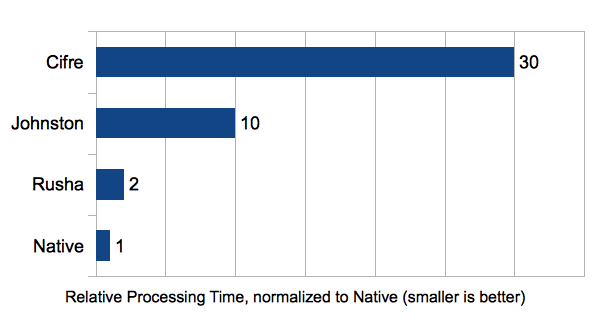\n\nResults per Implementation and Platform:\n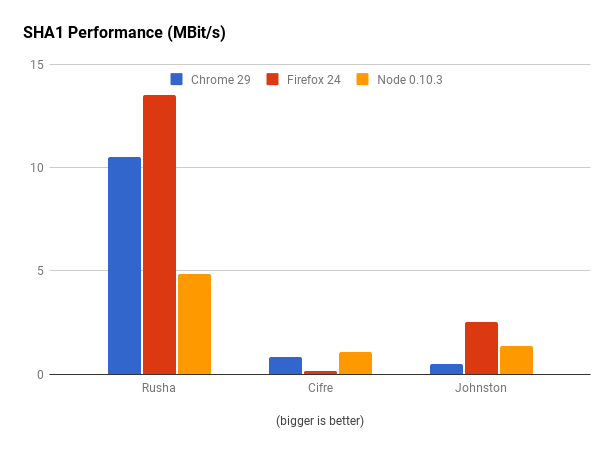\n\nAll tests were performed on a MacBook Air 1.7 GHz Intel Core i5 and 4 GB 1333 MHz DDR3.\n",
|
|
"bugs": {
|
|
"url": "https://github.com/srijs/rusha/issues"
|
|
},
|
|
"homepage": "https://github.com/srijs/rusha#readme",
|
|
"_id": "rusha@0.8.5",
|
|
"_shasum": "a30ae9bd5a4e80fbc96fbe7a13232b944be24f84",
|
|
"_resolved": "https://registry.npmjs.org/rusha/-/rusha-0.8.5.tgz",
|
|
"_from": "rusha@0.8.5"
|
|
}
|