 a11524896e
The lifecycle of `Path` objects are currently not managed by the user.
That is to say, there is no `dispose` method on path objects and
therefore no explicit way to detect when the user is done with the path
object and the native-side object can be exposed. As of right now, we
use `FinalizationRegistry` to clean up the native-side objects when the
dart-side objects are garbage collected. However, this has a number of
issues:
* Adding objects to the finalization registry actually ends up
prolonging their lifetime in V8, since the V8 garbage collector will
only collect them in a major GC and not a minor GC once they are
registered with the finalization registry. See the following Chrome bug:
https://issues.chromium.org/issues/340777103
* We can run into OOM issues where the linear memory of canvaskit/skwasm
exceeds 2GB if the collection of paths go on too long.
* Even if the paths do get collected by the GC, they often happen
infrequently enough that paths over many frames have accumulated and are
being collected all at once. This gap can often be dozens or hundreds of
frames long, and when collection does occur it is freeing a lot of paths
at once, which causes a janky frame. I have seen this take upwards of
800ms on my M1 Macbook Pro.

There are some more details in
https://github.com/flutter/flutter/issues/153678

This PR alleviates this issue by creating a `LazyPath` object. This
object is added to an arena that explicitly collects the underlying
native objects at the end of each frame. The object also tracks the API
calls made to it so that if it is actually used across a frame boundary
that we can recreate the native object if it was freed.

Running our benchmarks, this has a non-trivial performance cost to
building and using these paths (30-50% in a microbenchmark, 3-6% in a
broader full app benchmark). However, as a team we've decided that this
cost is worth it to avoid OOM issues as well as the non-deterministic
jank associated with large collections of these objects.






Flutter is Google's SDK for crafting beautiful, fast user experiences for mobile, web, and desktop from a single codebase. Flutter works with existing code, is used by developers and organizations around the world, and is free and open source.
Documentation
For announcements about new releases, follow the flutter-announce@googlegroups.com mailing list. Our documentation also tracks breaking changes across releases.
Terms of service
The Flutter tool may occasionally download resources from Google servers. By downloading or using the Flutter SDK, you agree to the Google Terms of Service: https://policies.google.com/terms
For example, when installed from GitHub (as opposed to from a prepackaged
archive), the Flutter tool will download the Dart SDK from Google servers
immediately when first run, as it is used to execute the flutter tool itself.
This will also occur when Flutter is upgraded (e.g. by running the flutter upgrade command).
About Flutter
We think Flutter will help you create beautiful, fast apps, with a productive, extensible and open development model, whether you're targeting iOS or Android, web, Windows, macOS, Linux or embedding it as the UI toolkit for a platform of your choice.
Beautiful user experiences
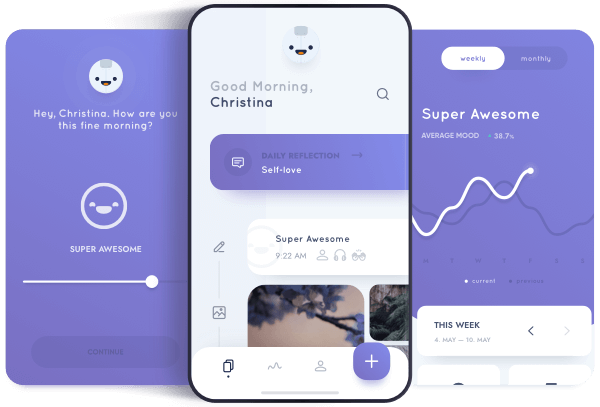
We want to enable designers to deliver their full creative vision without being forced to water it down due to limitations of the underlying framework. Flutter's layered architecture gives you control over every pixel on the screen and its powerful compositing capabilities let you overlay and animate graphics, video, text, and controls without limitation. Flutter includes a full set of widgets that deliver pixel-perfect experiences whether you're building for iOS (Cupertino) or other platforms (Material), along with support for customizing or creating entirely new visual components.
Fast results
Flutter is fast. It's powered by hardware-accelerated 2D graphics libraries like Skia (which underpins Chrome and Android) and Impeller. We architected Flutter to support glitch-free, jank-free graphics at the native speed of your device.
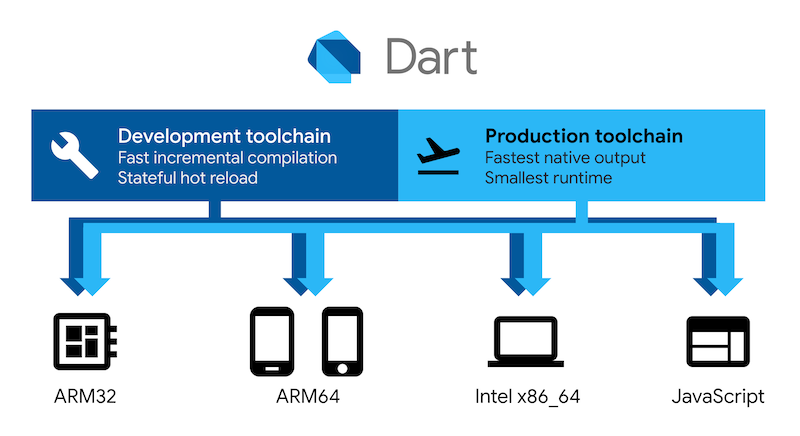
Flutter code is powered by the world-class Dart platform, which enables compilation to 32-bit and 64-bit ARM machine code for iOS and Android, JavaScript and WebAssembly for the web, as well as Intel x64 and ARM for desktop devices.
Productive development
Flutter offers stateful hot reload, allowing you to make changes to your code and see the results instantly without restarting your app or losing its state.

Extensible and open model
Flutter works with any development tool (or none at all), and also includes editor plug-ins for both Visual Studio Code and IntelliJ / Android Studio. Flutter provides tens of thousands of packages to speed your development, regardless of your target platform. And accessing other native code is easy, with support for both FFI (on Android, on iOS, on macOS, and on Windows) as well as platform-specific APIs.
Flutter is a fully open-source project, and we welcome contributions. Information on how to get started can be found in our contributor guide.