 975a677529
Our current
[adoption/documentation](https://docs.flutter.dev/platform-integration/ios/app-extensions)
for iOS Extensions does not currently work because it's disallowed to
nest bundles (see https://github.com/flutter/flutter/issues/142531).

As of [Xcode
13](https://developer.apple.com/documentation/xcode-release-notes/xcode-13-release-notes/#:~:text=Linking%20Swift%20packages%20from%20application%20extension%20targets%20or%20watchOS%20applications%20no%20longer%20emits%20unresolvable%20warnings%20about%20linking%20to%20libraries%20not%20safe%20for%20use%20in%20application%20extensions%2E),
linking to frameworks that contain non-extension-safe code no longer
gives warnings (or blocks from App Store it seems). Therefore, it has
become a runtime issue to ensure non-extension-safe code is not used.

Previously, we were building and shipping 2 separate
Flutter.xcframeworks. One that was extension-safe and one that was not.

This PR removes the "extension_safe" framework and instead makes the
entire framework extension-safe by annotating non-extension-safe code
with `NS_EXTENSION_UNAVAILABLE_IOS` and ensuring that code is not used
at runtime if the bundle is for an app extension.

This PR also disables wide gamut for app extensions to decrease the
chances of crashes (see
https://github.com/flutter/flutter/issues/165086).

Fixes https://github.com/flutter/flutter/issues/142531.

 ---

For reference:

App extensions were first evaluated in
https://flutter.dev/go/app-extensions. Here is the reasoning why neither
method described there is opportune.

Option 1 -
I did look into splitting the framework into 2 frameworks (one with all
extension-safe code and one with the non-extension-safe code). However,
the original idea was to use objc Categories/Extensions - this doesn’t
quite fit our needs. Categories/Extensions only allow you to add new
methods/properties, not override existing ones. We could hypothetically
add new methods, but that would require the user to change their code to
use the new methods.

I also looked into subclasses which does allow overrides, but it would
also require the user to change their code to use the new class.

We could do method swizzling, but opinion of that on the internet is
that it's not very safe.

I’m of the opinion that anything that requires the user to change code
isn’t super feasible due to plugins.

Option 2 -
We could still do the 2 frameworks but rename one to
`FlutterExtentionSafe`. This works without users needing to change any
code (including imports like `@import Flutter` / `#import
<Flutter/Flutter.h>`). I believe the reason this works is because at
compile time, it finds the `Flutter` framework on the framework search
path and it imports in the headers. Then at link time,
`FlutterExtentionSafe` is explicitly linked so it uses that framework
first when checking for symbols and since it finds all the symbols in
`FlutterExtentionSafe`, it doesn’t need/try to auto-link the `Flutter`
framework (despite `Flutter` being the framework imported).

This seems precarious to me since we’re relying on Xcode to not
auto-link the `Flutter` framework. If for some reason `Flutter`
framework did get auto-linked (such as the user using a symbol that’s
not in the `FlutterExtensionSafe` framework but is in the `Flutter`
framework - this is unlikely though), we’d get name collision issues

## Pre-launch Checklist

- [x] I read the [Contributor Guide] and followed the process outlined
there for submitting PRs.
- [x] I read the [Tree Hygiene] wiki page, which explains my
responsibilities.
- [x] I read and followed the [Flutter Style Guide], including [Features
we expect every widget to implement].
- [x] I signed the [CLA].
- [x] I listed at least one issue that this PR fixes in the description
above.
- [x] I updated/added relevant documentation (doc comments with `///`).
- [x] I added new tests to check the change I am making, or this PR is
[test-exempt].
- [x] I followed the [breaking change policy] and added [Data Driven
Fixes] where supported.
- [x] All existing and new tests are passing.

If you need help, consider asking for advice on the #hackers-new channel
on [Discord].

<!-- Links -->
[Contributor Guide]:
https://github.com/flutter/flutter/blob/main/docs/contributing/Tree-hygiene.md#overview
[Tree Hygiene]:
https://github.com/flutter/flutter/blob/main/docs/contributing/Tree-hygiene.md
[test-exempt]:
https://github.com/flutter/flutter/blob/main/docs/contributing/Tree-hygiene.md#tests
[Flutter Style Guide]:
https://github.com/flutter/flutter/blob/main/docs/contributing/Style-guide-for-Flutter-repo.md
[Features we expect every widget to implement]:
https://github.com/flutter/flutter/blob/main/docs/contributing/Style-guide-for-Flutter-repo.md#features-we-expect-every-widget-to-implement
[CLA]: https://cla.developers.google.com/
[flutter/tests]: https://github.com/flutter/tests
[breaking change policy]:
https://github.com/flutter/flutter/blob/main/docs/contributing/Tree-hygiene.md#handling-breaking-changes
[Discord]:
https://github.com/flutter/flutter/blob/main/docs/contributing/Chat.md
[Data Driven Fixes]:
https://github.com/flutter/flutter/blob/main/docs/contributing/Data-driven-Fixes.md






Flutter is Google's SDK for crafting beautiful, fast user experiences for mobile, web, and desktop from a single codebase. Flutter works with existing code, is used by developers and organizations around the world, and is free and open source.
Documentation
For announcements about new releases, follow the flutter-announce@googlegroups.com mailing list. Our documentation also tracks breaking changes across releases.
Terms of service
The Flutter tool may occasionally download resources from Google servers. By downloading or using the Flutter SDK, you agree to the Google Terms of Service: https://policies.google.com/terms
For example, when installed from GitHub (as opposed to from a prepackaged
archive), the Flutter tool will download the Dart SDK from Google servers
immediately when first run, as it is used to execute the flutter tool itself.
This will also occur when Flutter is upgraded (e.g. by running the flutter upgrade command).
About Flutter
We think Flutter will help you create beautiful, fast apps, with a productive, extensible and open development model, whether you're targeting iOS or Android, web, Windows, macOS, Linux or embedding it as the UI toolkit for a platform of your choice.
Beautiful user experiences
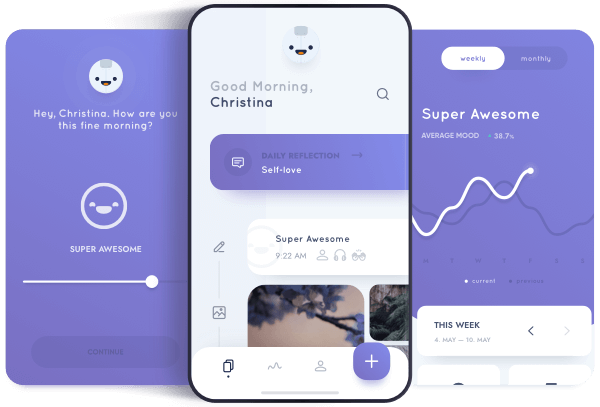
We want to enable designers to deliver their full creative vision without being forced to water it down due to limitations of the underlying framework. Flutter's layered architecture gives you control over every pixel on the screen and its powerful compositing capabilities let you overlay and animate graphics, video, text, and controls without limitation. Flutter includes a full set of widgets that deliver pixel-perfect experiences whether you're building for iOS (Cupertino) or other platforms (Material), along with support for customizing or creating entirely new visual components.
Fast results
Flutter is fast. It's powered by hardware-accelerated 2D graphics libraries like Skia (which underpins Chrome and Android) and Impeller. We architected Flutter to support glitch-free, jank-free graphics at the native speed of your device.
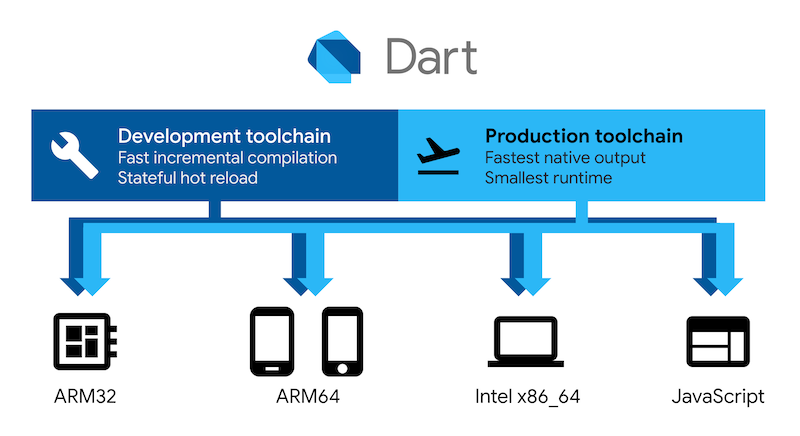
Flutter code is powered by the world-class Dart platform, which enables compilation to 32-bit and 64-bit ARM machine code for iOS and Android, JavaScript and WebAssembly for the web, as well as Intel x64 and ARM for desktop devices.
Productive development
Flutter offers stateful hot reload, allowing you to make changes to your code and see the results instantly without restarting your app or losing its state.

Extensible and open model
Flutter works with any development tool (or none at all), and also includes editor plug-ins for both Visual Studio Code and IntelliJ / Android Studio. Flutter provides tens of thousands of packages to speed your development, regardless of your target platform. And accessing other native code is easy, with support for both FFI (on Android, on iOS, on macOS, and on Windows) as well as platform-specific APIs.
Flutter is a fully open-source project, and we welcome contributions. Information on how to get started can be found in our contributor guide.