 5ecf10052f
This pull request aims to improve code readability, based on feedback gathered in a recent design doc.

<br>

There are two factors that hugely impact how easy it is to understand a piece of code: **verbosity** and **complexity**.

Reducing **verbosity** is important, because boilerplate makes a project more difficult to navigate. It also has a tendency to make one's eyes gloss over, and subtle typos/bugs become more likely to slip through.

Reducing **complexity** makes the code more accessible to more people. This is especially important for open-source projects like Flutter, where the code is read by those who make contributions, as well as others who read through source code as they debug their own projects.

<hr>

<br>

The following examples show how pattern-matching might affect these two factors:

<details> <summary><h3>Example 1 (GOOD)</h3> [click to expand]</summary>

```dart
if (ancestor case InheritedElement(:final InheritedTheme widget)) {
  themes.add(widget);
}
```

Without using patterns, this might expand to

```dart
if (ancestor is InheritedElement) {
  final InheritedWidget widget = ancestor.widget;
  if (widget is InheritedTheme) {
    themes.add(widget);
  }
}
```

Had `ancestor` been a non-local variable, it would need to be "converted" as well:

```dart
final Element ancestor = this.ancestor;
if (ancestor is InheritedElement) {
  final InheritedWidget inheritedWidget = ancestor.widget;
  if (widget is InheritedTheme) {
    themes.add(theme);
  }
}
```

</details>

<details> <summary><h3>Example 2 (BAD) </h3> [click to expand]</summary>

```dart
if (widget case PreferredSizeWidget(preferredSize: Size(:final double height))) {
  return height;
}
```

Assuming `widget` is a non-local variable, this would expand to:

```dart
final Widget widget = this.widget;
if (widget is PreferredSizeWidget) {
  return widget.preferredSize.height;
}
```

<br>

</details>

In both of the examples above, an `if-case` statement simultaneously verifies that an object meets the specified criteria and performs a variable assignment accordingly.

But there are some differences: Example 2 uses a more deeply-nested pattern than Example 1 but makes fewer useful checks.

**Example 1:**
- checks that `ancestor` is an `InheritedElement`
- checks that the inherited element's `widget` is an `InheritedTheme`

**Example 2:**
- checks that `widget` is a `PreferredSizeWidget`
(every `PreferredSizeWidget` has a `size` field, and every `Size` has a `height` field)

<br>

<hr>

I feel hesitant to try presenting a set of cut-and-dry rules as to which scenarios should/shouldn't use pattern-matching, since there are an abundance of different types of patterns, and an abundance of different places where they might be used.

But hopefully the conversations we've had recently will help us converge toward a common intuition of how pattern-matching can best be utilized for improved readability.

<br><br>

- resolves https://github.com/flutter/flutter/issues/152313
- Design Doc: [flutter.dev/go/dart-patterns](https://flutter.dev/go/dart-patterns)





Flutter is Google's SDK for crafting beautiful, fast user experiences for mobile, web, and desktop from a single codebase. Flutter works with existing code, is used by developers and organizations around the world, and is free and open source.
Documentation
For announcements about new releases, follow the flutter-announce@googlegroups.com mailing list. Our documentation also tracks breaking changes across releases.
Terms of service
The Flutter tool may occasionally download resources from Google servers. By downloading or using the Flutter SDK, you agree to the Google Terms of Service: https://policies.google.com/terms
For example, when installed from GitHub (as opposed to from a prepackaged
archive), the Flutter tool will download the Dart SDK from Google servers
immediately when first run, as it is used to execute the flutter tool itself.
This will also occur when Flutter is upgraded (e.g. by running the flutter upgrade command).
About Flutter
We think Flutter will help you create beautiful, fast apps, with a productive, extensible and open development model, whether you're targeting iOS or Android, web, Windows, macOS, Linux or embedding it as the UI toolkit for a platform of your choice.
Beautiful user experiences
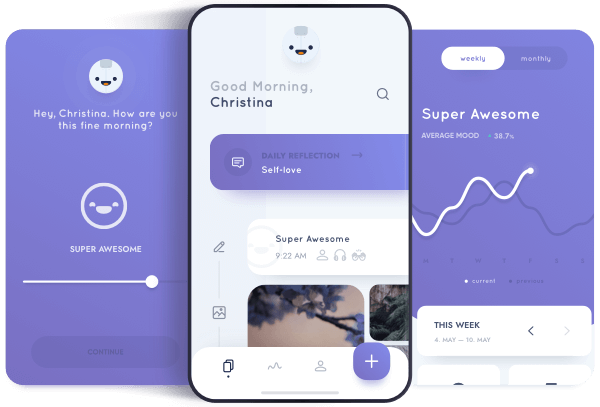
We want to enable designers to deliver their full creative vision without being forced to water it down due to limitations of the underlying framework. Flutter's layered architecture gives you control over every pixel on the screen and its powerful compositing capabilities let you overlay and animate graphics, video, text, and controls without limitation. Flutter includes a full set of widgets that deliver pixel-perfect experiences whether you're building for iOS (Cupertino) or other platforms (Material), along with support for customizing or creating entirely new visual components.
Fast results
Flutter is fast. It's powered by hardware-accelerated 2D graphics libraries like Skia (which underpins Chrome and Android) and Impeller. We architected Flutter to support glitch-free, jank-free graphics at the native speed of your device.
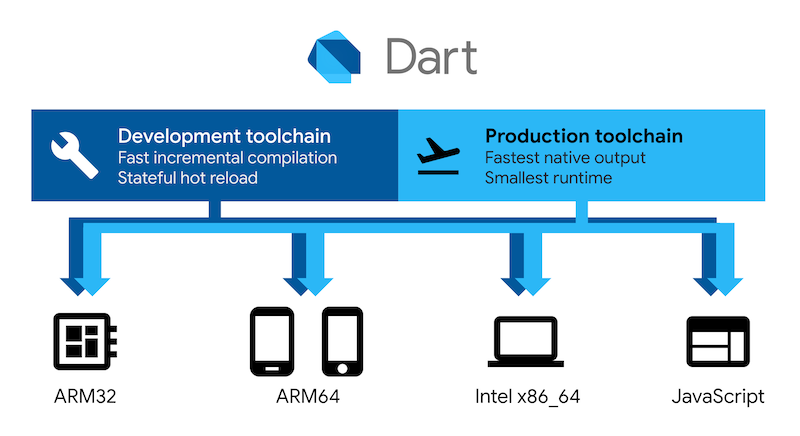
Flutter code is powered by the world-class Dart platform, which enables compilation to 32-bit and 64-bit ARM machine code for iOS and Android, JavaScript and WebAssembly for the web, as well as Intel x64 and ARM for desktop devices.
Productive development
Flutter offers stateful hot reload, allowing you to make changes to your code and see the results instantly without restarting your app or losing its state.

Extensible and open model
Flutter works with any development tool (or none at all), and also includes editor plug-ins for both Visual Studio Code and IntelliJ / Android Studio. Flutter provides tens of thousands of packages to speed your development, regardless of your target platform. And accessing other native code is easy, with support for both FFI (on Android, on iOS, on macOS, and on Windows) as well as platform-specific APIs.
Flutter is a fully open-source project, and we welcome contributions. Information on how to get started can be found in our contributor guide.