This pull request fixes#143803 by taking advantage of Dart's null-aware operators.
And unlike `switch` expressions ([9 PRs](https://github.com/flutter/flutter/pull/143634) and counting), the Flutter codebase is already fantastic when it comes to null-aware coding. After refactoring the entire repo, all the changes involving `?.` and `??` can fit into a single pull request.
My RenderSliverMultiBoxAdaptor/RenderSliverFixedExtentList/RenderSliverVariedExtentList yak shave continues.
I've been subclassing RenderSliverVariedExtentList for SliverTree and have found some opportunities for clean up.
There is a larger clean up I'd like to do, but this week SliverTree comes first.
I noticed these methods were getting repeated ð, and I was about to repeat them again ð for the tree, so I figured bumping them up to the base class was better than continuing to copy-paste the same methods.
Multiple methods in `RenderSliverFixedExtentBoxAdaptor` pass a `double itemExtent` for computing things like what children will be laid out, what the max scroll offset will be, and how the children will be laid out.
Since `RenderSliverFixedExtentBoxAdaptor` was further subclassed to support a `itemExtentBuider` in `RenderSliverVariedExtentList`, these itemExtent parameters became useless when using that RenderObject. Reading through `RenderSliverFixedExtentBoxAdaptor.performLayout`, the remaining artifacts of passing around itemExtent make it hard to follow when it is irrelevant.
`RenderSliverFixedExtentBoxAdaptor.itemExtent` is available from these methods, so it does not need to pass it. It is redundant API.
Plus, if a bogus itemExtent is passed for some reason, errors will ensue and the layout will be incorrect. ð£ ð¥
Deprecating so we can remove these for a cleaner API. Unfortunately this is not supported by dart fix, but the fact that these methods are protected means usage outside of the framework is likely minimal.
Fixes https://github.com/flutter/flutter/issues/79495

This is basically a reland of https://github.com/flutter/flutter/pull/79607.

Currently when the cursor is invalid, arrow key navigation / typing / backspacing doesn't work since the cursor position is unknown.
Showing the cursor when the selection is invalid gives the user the wrong information about the current insert point in the text.

This is going to break internal golden tests.
Reverts flutter/flutter#142339

In the original change one of the tests included the same view twice which resulted in a different failure than the expected one. The second commit contains the fix for this. I don't understand how this wasn't caught presubmit on CI.
Reverts flutter/flutter#141484
Initiated by: eliasyishak
This change reverts the following previous change:
Original Description:
The existing `runApp` bootstraps the widget tree and renders the provided widget into the default view (which is currently the implicit View from `PlatformDispatcher.implicitView` and - in the future - may be a default-created window). Apps, that want more control over the View they are rendered in, need a new way to bootstrap the widget tree: `runWidget`. It does not make any assumptions about the View the provided widget is rendered into. Instead, it is up to the caller to include a View widget in the provided widget tree that specifies where content should be rendered. In the future, this may enable developers to create a custom window for their app instead of relying on the default-created one.
The existing `runApp` bootstraps the widget tree and renders the provided widget into the default view (which is currently the implicit View from `PlatformDispatcher.implicitView` and - in the future - may be a default-created window). Apps, that want more control over the View they are rendered in, need a new way to bootstrap the widget tree: `runWidget`. It does not make any assumptions about the View the provided widget is rendered into. Instead, it is up to the caller to include a View widget in the provided widget tree that specifies where content should be rendered. In the future, this may enable developers to create a custom window for their app instead of relying on the default-created one.
Much nicer calling API and simplifies evolving this API in the future.

I wish we could write a dart fix for this, but that's blocked on https://github.com/dart-lang/sdk/issues/54668.
- Unskip `text_style_test` for CanvasKit.
- Remove no longer necessary `kIsWeb` checks in a few tests.

This PR depends on https://github.com/flutter/engine/pull/49786, which rolled into the framework. If the engine PR needs to be reverted, this PR will need to be reverted too.
This disables the expectation for `TileMode` stringification because
https://github.com/flutter/engine/pull/49786 is about to fix it (as in,
the test would fail when the engine fix lands).
This reverts commit
d24c01bd0c.

The original change was reverted because it caused some apps to get
stuck on the splash screen on some phones.

An investigation determined that this was due to a rounding error.
Example: The device reports a physical size of 1008.0 x 2198.0 with a
dpr of 1.912500023841858. Flutter would translate that to a logical size
of 527.0588169589221 x 1149.2810314243163 and use that as the input for
its layout algorithm. Since the constraints here are tight, the layout
algorithm would determine that the resulting logical size of the root
render object must be 527.0588169589221 x 1149.2810314243163.
Translating this back to physical pixels by applying the dpr resulted in
a physical size of 1007.9999999999999 x 2198.0 for the frame. Android
now rejected that frame because it didn't match the expected size of
1008.0 x 2198.0 and since no frame had been rendered would never take
down the splash screen.

Prior to dynamically sized views, this wasn't an issue because we would
hard-code the frame size to whatever the requested size was.

Changes in this PR over the original PR:

* The issue has been fixed now by constraining the calculated physical
size to the input physical constraints which makes sure that we always
end up with a size that is acceptable to the operating system.
* The `ViewConfiguration` was refactored to use the slightly more
convenient `BoxConstraints` over the `ViewConstraints` to represent
constraints. Both essentially represent the same thing, but
`BoxConstraints` are more powerful and we avoid a couple of translations
between the two by translating the` ViewConstraints` from the
`FlutterView` to `BoxConstraints` directly when the `ViewConfiguration`
is created.

All changes over the original PR are contained in the second commit of
this PR.

Fixes b/316813075
Part of https://github.com/flutter/flutter/issues/134501.
Fix and unskip the following CanvasKit tests:

- `test/painting/decoration_test.dart`
- `test/rendering/layers_test.dart`
- `test/widgets/app_overrides_test.dart`
Fixes https://github.com/flutter/flutter/issues/131435, https://github.com/flutter/flutter/issues/104594, https://github.com/flutter/flutter/issues/43400

Currently the method we use for text span hit testing `TextPainter.getPositionForOffset` always returns the closest `TextPosition`, even when the given offset is far away from the text.

The new TextPaintes method tells you the layout bounds `(width =  letterspacing / 2 + x_advance + letterspacing / 2, height = font ascent + font descent)` of a character, the PR changes the hit testing implementation such that a TextSpan is only considered hit if the point-down event landed in one of its character's layout bounds.

Potential issues:

In theory since the text is baseline aligned, we should use the max ascent and max descent of each character to calculate the height of the text span's hit-test region, in case some characters in the span have to fall back to a different font, but that will be slower and it typically doesn't make a huge difference.
This is a breaking change.
I want to build a widget that adds some extra functionality when the inner text overflow. So the problem occurred, I can't find an elegant way to determine if the text is overflowing.
So i expose `didExceedMaxLines` from `RenderParagraph`, I think it can make sense. Have there some advice?
Reverts flutter/flutter#139717
Initiated by: LongCatIsLooong
This change reverts the following previous change:
Original Description:
Fixes https://github.com/flutter/flutter/issues/131435, #104594, #43400
Needs https://github.com/flutter/engine/pull/48774 (to fix the web test failure).

Currently the method we use for text span hit testing `TextPainter.getPositionForOffset` always returns the closest `TextPosition`, even when the given offset is far away from the text.

The new TextPaintes method tells you the layout bounds (`width =  letterspacing / 2 + x_advance + letterspacing / 2`, `height = font ascent + font descent`) of a character, the PR changes the hit testing implementation such that a TextSpan is only considered hit if the point-down event landed in one of it's character's layout bounds.

Potential issues:

1. In theory since the text is baseline aligned, we should use the max ascent and max descent of each character to calculate the height of the text span's hit-test region, in case some characters in the span have to fall back to a different font, but that will be slower and it typically doesn't make a huge difference.

This is a breaking change. It also introduces a new finder and a new method `WidgetTester.tapOnText`: `await tester.tapOnText('string to match')` for ease of migration.
Fixes https://github.com/flutter/flutter/issues/131435, #104594, #43400
Needs https://github.com/flutter/engine/pull/48774 (to fix the web test failure).

Currently the method we use for text span hit testing `TextPainter.getPositionForOffset` always returns the closest `TextPosition`, even when the given offset is far away from the text.

The new TextPaintes method tells you the layout bounds (`width =  letterspacing / 2 + x_advance + letterspacing / 2`, `height = font ascent + font descent`) of a character, the PR changes the hit testing implementation such that a TextSpan is only considered hit if the point-down event landed in one of it's character's layout bounds.

Potential issues:

1. In theory since the text is baseline aligned, we should use the max ascent and max descent of each character to calculate the height of the text span's hit-test region, in case some characters in the span have to fall back to a different font, but that will be slower and it typically doesn't make a huge difference.

This is a breaking change. It also introduces a new finder and a new method `WidgetTester.tapOnText`: `await tester.tapOnText('string to match')` for ease of migration.
Towards https://github.com/flutter/flutter/issues/134501.

This change is based on https://github.com/flutter/engine/pull/48090. It changes the `RenderView` to be dynamically sized based on its content if the `FlutterView` it is configured with allows it (i.e. the `FlutterView` has loose `FlutterView.physicalConstraints`). For that, it uses those `physicalConstraints` as input to the layout algorithm by passing them on to its child (after translating them to logical constraints via the device pixel ratio). The resulting `Size` that the `RenderView` would like to be is then communicated back to the engine by passing it to the `FlutterView.render` call.

Tests will fail until https://github.com/flutter/engine/pull/48090 has rolled into the framework.
This updates the implementation to use the stopwatch from the Clock object and pipes it through to the TestWidgetsFlutterBinding so it will be kept in sync with FakeAsync.

Relands https://github.com/flutter/flutter/pull/138843 attempted to reland https://github.com/flutter/flutter/pull/137381 which attempted to reland #132291
Fixes https://github.com/flutter/flutter/issues/97761

1. The original change was reverted due to flakiness it introduced in tests that use fling gestures.
  * Using a mocked clock through the test binding fixes this now
2. It was reverted a second time because a change at tip of tree broke it, exposing memory leaks, but it was not rebased before landing.
  * These leaks are now fixed
3. It was reverted a third time, because we were so excellently quick to revert those other times, that we did not notice the broken benchmark that only runs in postsubmit.
  * The benchmark is now fixed
**What has been done?**
----------------------
Added new enumeration in `TableCellVerticalAlignment`, which sets the cell size to the same as the topmost cell. There are no noticeable problems in using it in all cells together, as there are in `TableCellVerticalAlignment.fill` which is made not to be used in all cells together because it has another purpose.
**Explanation of the logic**
----------------------
An assignment was made (which already existed in `TableCellVerticalAlignment.top; middle and bottom`) that assigns `rowHeight` the maximum double between the initialized height and the height of its child.

Basically, defining a minimum cell height based on its child, and letting each table row have its own height stipulated from the largest element, creating an `IntrinsicHeight` for TableCell automatically.

As the `TableCellVerticalAlignment` logic already provides for the use of the height of the largest cell in the row, it was possible to reuse this logic, and just not make the break statement that exists to fill in the calculation for `intrinsicHeight`.
Real example in an Android application after added enumeration
----------------------
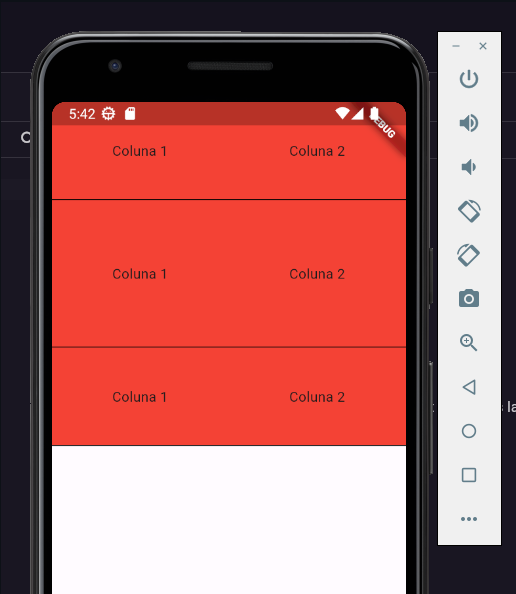
Opened issue
----------------------
FIX: #130261
Reverts flutter/flutter#137381
Initiated by: Piinks
This change reverts the following previous change:
Original Description:
This updates the implementation to use the stopwatch from the Clock object and piping it through to the TestWidgetsFlutterBinding so it will be kept in sync with FakeAsync.

Relands #132291
Fixes https://github.com/flutter/flutter/issues/97761

The change was reverted due to flakiness it introduced in tests that use fling gestures.
* https://github.com/flutter/flutter/issues/135728
Before this change, long-running post-frame callbacks wouldn't show up in the timeline at all.  This adds a timeline event for post-frame callbacks, with a debug flag that will add timeline events for each individual callback.

#testexempt -- we have no way to test calls to the timeline.
Some render box subclasses have a specific layout contract that is tightly coupled with other render box subclasses (e.g. two private classes in a local project file). In these cases, it is also possible that they use a constraints object that is a subclass of `BoxConstraints`. To allow for this, this change makes the `constraints` argument to `RenderBox.computeDryLayout()` a covariant argument.

For completeness' sake, this updates the other render objects in the rendering package to also use the covariant keyword for this argument.
This change collapses the selection at the clicked/tapped location on single click down for desktop platforms, and on single click/tap up for mobile platforms to match native.

This is a change from how `SelectionArea` previously worked. Before this change a single click down would clear the selection. From observing a native browser it looks like when tapping on static text the selection is not cleared but collapsed. A user can still attain the selection from static text using the `window.getSelection` API.

https://jsfiddle.net/juepasn3/11/ You can try this demo out here to observe this behavior yourself. When clicking on static text the selection will change.

This change also allows `Paragraph.selections` to return selections that are collapsed. This for testing purposes to confirm where the selection has been collapsed.

Partially fixes: #129583
Fixes https://github.com/flutter/flutter/issues/59413

This relocates `mock_canvas.dart` and `recording_canvas.dart` from `flutter/test/rendering` to `flutter_test`.

The testing functionality afforded by mock_canvas should be available to everyone, not just the framework. :)

mock_canvas.dart needed a bit of cleanup - things like formatting and super parameters.
Fixes https://github.com/flutter/flutter/issues/131467

An error in the flex methods of min and max column width would produce different results based on the position of the widths that were provided:
`MaxColumnWidth(a, b) != MaxColumnWidth(b, a)`

This fixes that.
