This works around https://g-issues.skia.org/issues/40044713 using exponential backoff.

This is completely untested because I have no idea how to test it.

Also I only changed one of the code paths here. I figure if we get success here then we can start propagating the change to other places in this file that generate errors, maybe factoring out the retry and error reporting logic so it's not duplicated multiple times.
Closes #137116
<b>Before</b>
VS Code Insiders installed via Snap isn't detected.
<b>After</b>
```sh
[â] VS Code (version 1.84.0-insider)
⢠VS Code at /snap/code-insiders/current/usr/share/code-insiders
⢠Flutter extension version 3.75.20231002
```
This change adds a feature to `UndoHistory` that allows the user to modify the value being pushed onto the undo stack.
This is used by the framework to ignore the composing region when pushing history entries to the Undo stack on Android. This is so an undo does not trigger an input connection restart by the Android TextInputPlugin, which occurs when the framework changes the composing region. This is also the native platform behavior observed in Google Keep app on Android, where doing an undo during composing reverts to the previous state but with composing inactive and a subsequent redo does not bring back the composing region.
Fixes#130881
Partial fix for #134398
Fixes#11884
As #38926 pointed out, the current Flutter implementation of multi-finger drag behavior is different from iOS and Android.
This change introduces the `MultitouchDragStrategy` attribute, which implements the Android behavior and can be controlled through `ScrollBehavior`, while retaining the ability to extend iOS behavior in the future.
Addresses #63507, and is a follow up to the engine PR https://github.com/flutter/engine/pull/46857
Changes the font family string when attempting to use Apple system fonts to the new proxies added by the engine. For the "Text" font this will be more secure in the future against possible changes to Apple's API. For the "Display" font, this will now work correctly when it didn't before.
I checked the letter spacing values against a native app for all font sizes between 17-28. I made a few adjustments to better match native, but especially for the "Text" font we were either really close, or close enough to not make a large breaking change to default fonts worth it.
| Before | After |
| ------------- | ------------- |
| <img width="466" alt="Screenshot 2023-11-02 at 11 45 12â¯AM" src="https://github.com/flutter/flutter/assets/58190796/627ed8ac-d848-4f71-aa62-a467b8aac62d"> | <img width="383" alt="Screenshot 2023-11-02 at 11 46 25â¯AM" src="https://github.com/flutter/flutter/assets/58190796/9a502021-7d2b-4e14-98f1-86971b3830a5"> |
The smaller text in both the before and after should be the same. The large system font that Flutter used before was incorrect, which caused it to look more spread out. Now we use the correct font.
Towards https://github.com/flutter/flutter/issues/134501.

This change is based on https://github.com/flutter/engine/pull/48090. It changes the `RenderView` to be dynamically sized based on its content if the `FlutterView` it is configured with allows it (i.e. the `FlutterView` has loose `FlutterView.physicalConstraints`). For that, it uses those `physicalConstraints` as input to the layout algorithm by passing them on to its child (after translating them to logical constraints via the device pixel ratio). The resulting `Size` that the `RenderView` would like to be is then communicated back to the engine by passing it to the `FlutterView.render` call.

Tests will fail until https://github.com/flutter/engine/pull/48090 has rolled into the framework.
This PR adds the ability to get the `sourceTimeStamp` from `ScaleUpdateDetails` in a `GestureScaleUpdateCallback` like so:

```dart
onScaleUpdate: (ScaleUpdateDetails details){
  print(details.sourceTimeStamp);
}
```

`sourceTimeStamp` is necessary when tracking velocity eg.

```dart
VelocityTracker tracker = VelocityTracker.withKind(PointerDeviceKind.touch);
///...
onScaleUpdate: (ScaleUpdateDetails details){
  tracker.addPosition(details.sourceTimeStamp!, details.focalPoint);
}
```

The docs say:

>Having both a pan gesture recognizer and a scale gesture recognizer is redundant; scale is a superset of pan. Just use the scale gesture recognizer.

Currently this is not entirely accurate, and should be fixed, as noted in https://github.com/flutter/flutter/issues/43833#issuecomment-548133779. This PR does not add `sourceTimeStamp` to `ScaleStartDetails` because it is more involved. Specifically, `ScaleStartDetails` can be created in `acceptGesture` which does not have access to the `PointerEvent` to get the `event.timeStamp` (54fa255432/packages/flutter/lib/src/gestures/scale.dart (L730C5-L730C5)).

fixes https://github.com/flutter/flutter/issues/135873. See also https://github.com/flutter/flutter/issues/43833 which added delta and https://github.com/flutter/flutter/issues/49025 which added `numPointers` to `ScaleUpdateDetails` for the reason given above. `sourceTimeStamp` should probably be added to `ScaleStartDetails` as well because it exists in `DragStartDetails` and therefore in `onPanStart`.

I am not sure how to add tests for this, any input about this PR would be appreciated.

- [] All existing and new tests are passing.
Part of https://github.com/flutter/flutter/issues/139243

## Description

This removes the `PlatformMenuBar.body` attribute and constructor parameter, since its deprecation period has elapsed.

## Tests
 - No tests were using the deprecated attribute, so no tests were removed.

#FlutterDeprecations
This updates the implementation to use the stopwatch from the Clock object and pipes it through to the TestWidgetsFlutterBinding so it will be kept in sync with FakeAsync.

Relands https://github.com/flutter/flutter/pull/138843 attempted to reland https://github.com/flutter/flutter/pull/137381 which attempted to reland #132291
Fixes https://github.com/flutter/flutter/issues/97761

1. The original change was reverted due to flakiness it introduced in tests that use fling gestures.
  * Using a mocked clock through the test binding fixes this now
2. It was reverted a second time because a change at tip of tree broke it, exposing memory leaks, but it was not rebased before landing.
  * These leaks are now fixed
3. It was reverted a third time, because we were so excellently quick to revert those other times, that we did not notice the broken benchmark that only runs in postsubmit.
  * The benchmark is now fixed
- fix https://github.com/flutter/flutter/issues/53707 by having the test not expect a timeout but instead actually look for the retry message
- simplify the `--task` option to only accept task names rather than also accepting paths
- remove some obsolete options that referred to the manifest which no longer seems to exist
This change adds support for a `MaterialStatesController` in `TextField` and `TextFormField`. With this change a user can listen to `MaterialState` changes in an input field by passing a `MaterialStatesController` to `TextField` or `TextFormField`.
Fixes#133273
Provide a parameter `applyTextScaling` to both `Icon` and `IconDataTheme`. When `true`, the context's `TextScaler` will apply it's `scale` method to the icon size.
Fixes#115466
**What has been done?**
----------------------
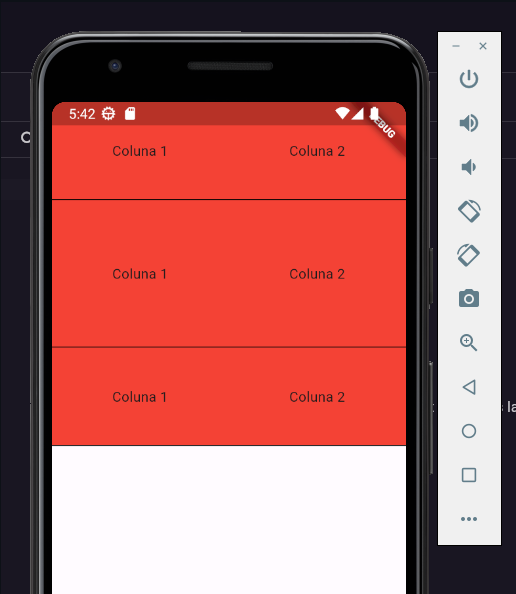
Added new enumeration in `TableCellVerticalAlignment`, which sets the cell size to the same as the topmost cell. There are no noticeable problems in using it in all cells together, as there are in `TableCellVerticalAlignment.fill` which is made not to be used in all cells together because it has another purpose.
**Explanation of the logic**
----------------------
An assignment was made (which already existed in `TableCellVerticalAlignment.top; middle and bottom`) that assigns `rowHeight` the maximum double between the initialized height and the height of its child.

Basically, defining a minimum cell height based on its child, and letting each table row have its own height stipulated from the largest element, creating an `IntrinsicHeight` for TableCell automatically.

As the `TableCellVerticalAlignment` logic already provides for the use of the height of the largest cell in the row, it was possible to reuse this logic, and just not make the break statement that exists to fill in the calculation for `intrinsicHeight`.
Real example in an Android application after added enumeration
----------------------
Opened issue
----------------------
FIX: #130261
Fixes https://github.com/flutter/flutter/issues/138592.

In an `Icon` widget if the icon font's body (ascender + descender) is larger than the font's units per em, the icon height reported by the text layout library will be larger than the specified font size. When that happens the icon glyph gets pushed towards the bottom because the `Icon` widget is wrapped in a fontSize x fontSize SizedBox and thus has a fixed height of fontSize px. This wasn't a problem for material icons because its UPEM == body.
## Description

This PR fixes an inversion on `MediaQuery.textScalerOf` and  `MediaQuery.maybeTextScalerOf `documentation.

## Related Issue

Fixes https://github.com/flutter/flutter/issues/139071

## Tests

Documentation only
This PR updates the app templates generated by `flutter create` to use declarative `plugins {}` syntax for applying the Kotlin Gradle Plugin.

I realized this is missing while writing [#9857.](https://github.com/flutter/website/pull/9857)
Checks `pod install` output for the case where a pod requires a higher minimum OS deployment target version than the app is set to use, and attempts to turn it into a more actionable error message. This isn't foolproof since we are parsing the Ruby rather than actually executing it, but I would expect that the vast majority of cases would end up in the most useful version (and even those that don't are still much clearer with this as the final error message text than without it).

Fixes https://github.com/flutter/flutter/issues/113762
`FakeView` wraps the same underlying `FlutterView`. Sending semantics updates and Scene objects from multiple fake views into the same engine `FlutterView` violates contracts with the engine. This PR stubs out `render` and `updateSemantics` methods in `FakeView` classes to prevent that.

This unblocks https://github.com/flutter/engine/pull/48251, which implements multi-view semantics for web.
Relates to tracker issue:
- https://github.com/flutter/flutter/issues/128251

This PR includes 3 major updates:
- Adding the `commandHasTerminal` parameter for `Event.flutterCommandResult`
  - In `packages/flutter_tools/lib/src/runner/flutter_command.dart`
- Adding the new event for `sendException` from package:usage to be `Event.exception` (this event can be used by all dash tools)
  - In `packages/flutter_tools/lib/runner.dart`
- Migrating the generic `UsageEvent` which was only used for Apple related workflows for iOS and macOS. I did an initial analysis in this [sheet](https://docs.google.com/spreadsheets/d/11KJLkHXFpECMX7tw-trNkYSr5MHDG15XNGv6TgLjfQs/edit?resourcekey=0-j4qdvsOEEg3wQW79YlY1-g#gid=0) to identify all the call sites
  - Found in several files, highlighted in the sheet above
