Reverts flutter/flutter#141484
Initiated by: eliasyishak
This change reverts the following previous change:
Original Description:
The existing `runApp` bootstraps the widget tree and renders the provided widget into the default view (which is currently the implicit View from `PlatformDispatcher.implicitView` and - in the future - may be a default-created window). Apps, that want more control over the View they are rendered in, need a new way to bootstrap the widget tree: `runWidget`. It does not make any assumptions about the View the provided widget is rendered into. Instead, it is up to the caller to include a View widget in the provided widget tree that specifies where content should be rendered. In the future, this may enable developers to create a custom window for their app instead of relying on the default-created one.
The existing `runApp` bootstraps the widget tree and renders the provided widget into the default view (which is currently the implicit View from `PlatformDispatcher.implicitView` and - in the future - may be a default-created window). Apps, that want more control over the View they are rendered in, need a new way to bootstrap the widget tree: `runWidget`. It does not make any assumptions about the View the provided widget is rendered into. Instead, it is up to the caller to include a View widget in the provided widget tree that specifies where content should be rendered. In the future, this may enable developers to create a custom window for their app instead of relying on the default-created one.
fix https://github.com/flutter/flutter/issues/121493
`SegmentedButton` uses `TextButton` for each segments. When we have `MaterialTapTargetSize.padded` for `TextButton`, we make sure the minimum tap target size is 48.0( this value can be adjusted by visual density), even tough the actual button size is smaller. When `SegmentedButton` paints segments by using `MultiChildRenderObjectWidget`, it also includes the tap target size so the button that it actually draws always has the same height as the height of the tap target size.
To fix it, this PR firstly calculate the actual height of a text button in `SegmentedButton` class, then we can get the height delta if there is. Then the the value of (Segmented button render box height - the delta) would be the actual button size that we should see.
For now, we are not able to customize the min, max, fixed size in [`SegmentedButton` style](https://api.flutter.dev/flutter/material/SegmentedButton/style.html). So the standard button height is always 40 and can only be customized by `style.visualDensity` and `style.tapTargetSize`; `SegmentedButton` only simulates the `TextButton` behavior when `TextButton`'s height is its default value.

https://github.com/flutter/flutter/assets/36861262/15ca6034-e6e0-4cc6-8fe3-808b4bd6a920
Fixes#129590
* Consider `AxisDirection` when calculating scroll offset used in determining TextSelection during a drag/long press drag. Previously it seems that we were assuming the direction was always vertical 30cc831985/packages/flutter/lib/src/widgets/text_selection.dart (L2842-L2844) .
* SelectableText now considers RenderEditable offset changes and Scrollable offset changes when calculating the TextSelection during a long press drag.
Much of the new wording here is borrowed from [ChipTheme], [SliderTheme], or [RadioThemeData], which I think are pretty good. I believe a lot of other theme classes have similar wording too. I've also made some tweaks of my own, notably the references to [MaterialApp.theme].

This started from a desire to have clearer cross-references pointing at what to do with a FooThemeData to make it take effect:
  https://github.com/flutter/flutter/pull/135879#discussion_r1355851481
but then as I started writing I kept finding more and more small things I wanted to adjust, including a couple of bits that were extraneous or obsolete.
Fixes#141347
This PR is to add a "clear text" tooltip for the clear button on `SearchAnchor`'s search view and also add a `clearButtonTooltip` entry for `material_localizations`.
It's confusing that `debugPrint` also prints in release mode, given that a lot (most?) other things prefixed with `debug` don't do anything in release mode. Therefore, this adds some documentation that this is indeed logging in release mode and adds an example how to disable this.

*If you had to change anything in the [flutter/tests] repo, include a link to the migration guide as per the [breaking change policy].*
When a `TextField` is rendered before a `Navigator`, it breaks in semantics mode.  This is because the framework generates the incorrect semantics tree (excludes the TextField) and when that tree gets sent to the engine, we don't get the signal to create the corresponding `<input>` element.

This happens for a few reasons:
* `ModalBarrier` uses `BlockSemantics` to drop the semantics of routes beneath the current route in `Navigator`
* `ModalBarrier` mistakenly recognizes the widget outside of the `Navigator` to be its sibling
*  So we end up dropping the semantics node of the `TextField` rendered before it.

The fix is to let `Navigator` generate a semantics node so that `ModalBarrier` doesn't mistakenly think widgets outside of `Navigator` are its siblings.

`Navigator` doesn't currently do this, which causes all the nodes generated from its widget subtree to be directly attached to the parent semantics node above `Navigator` - since this is also the parent of `TextField`, it considers them siblings.

Fixes https://github.com/flutter/flutter/issues/129324
This PR adds the Dart VM `vm:platform-const-if` pragma introduced in
https://github.com/dart-lang/sdk/commit/57a1168875 to the
`defaultTargetPlatform` property, allowing it to be computed as if it
was a constant field in non-debug AOT builds. In particular, this means
that platform-specific code executed conditionally based on this
property can be tree-shaken in release builds. Note that this PR changes
`defaultTargetPlatform` to only allow overriding via
`debugDefaultTargetPlatformOverride` in debug builds, and makes it so
that compilation throws an error if code assigns
to`debugDefaultTargetPlatformOverride` in other build modes.

Related issue: #14233

## Pre-launch Checklist

- [X] I read the [Contributor Guide] and followed the process outlined
there for submitting PRs.
- [X] I read the [Tree Hygiene] wiki page, which explains my
responsibilities.
- [X] I read and followed the [Flutter Style Guide], including [Features
we expect every widget to implement].
- [X] I signed the [CLA].
- [X] I listed at least one issue that this PR fixes in the description
above.
- [X] I updated/added relevant documentation (doc comments with `///`).
- [X] I added new tests to check the change I am making, or this PR is
[test-exempt].
- [X] All existing and new tests are passing.
Remove more `textScaleFactor` references from flutter/flutter.

- Some changes are related to label scaling: the padding EdgeInsets values of some chip subclasses scale linearly between predetermined "max" padding values and "min" padding values. Before they scale with the `textScaleFactor` scalar, now they scale with the font size and are still capped at the original "max" and "min" values.
- The rest of them are tests or size heuristics that depend on `textScaleFactor`, these are replaced by an effective text scale factor computed using a default font size (which is determined in a pretty random fashion, but it will only make a difference on Android 14+).

No API changes in this batch. There are still some references left that I intend to remove in a different batch that would introduce API changes.
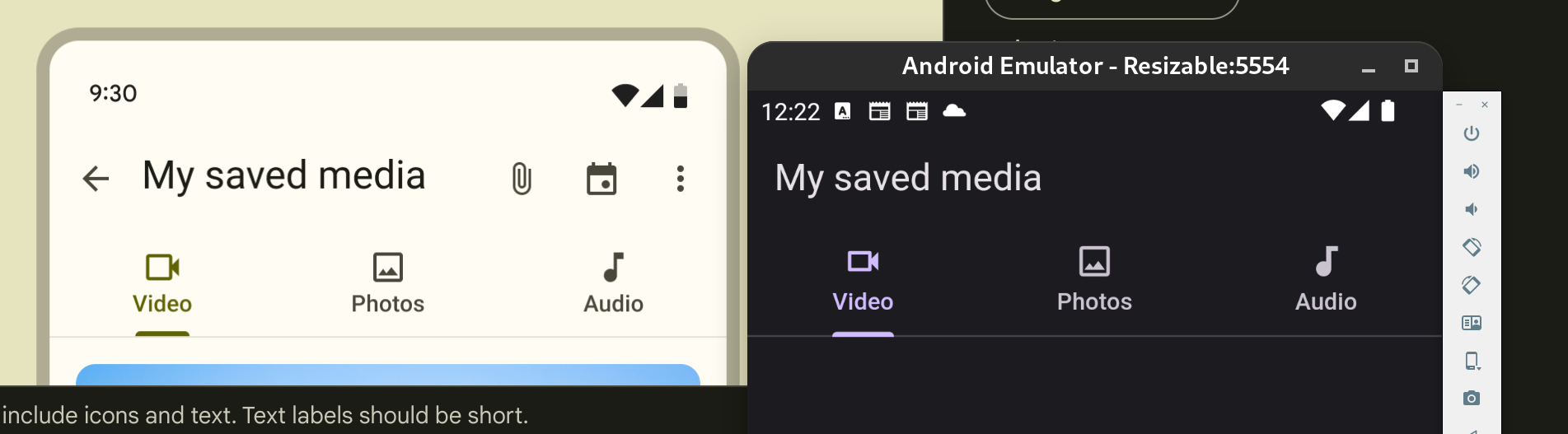
This PR improves the distance between the label and the icon in the Tab widget.
I updated the margin to 2 pixels, taken from the Figma design page for Material 3. On Material 2 I left the default value of 10 pixels.
Related to #128696 (In particular, the distance between label and icon)
Here are some screenshots for comparison. I looked a bit into the other mentioned issue of the tab height not following the M3 spec. Flutter uses 72 and the spec uses 64. But because Tab is a PreferredSizeWidget, I don't think there is an easy way to provide a different size depending on `ThemeData.useMaterial3`, because there is no `BuildContext` available.
I provide a sample image for the 64 height as well for context on the linked issue, even though it's not part of the PR changes.
The screenshots are taken side by side with the image at: https://m3.material.io/components/tabs/guidelines
## Original

## New (tab height = 72, Flutter default for 8 years)

## New (tab height = 64, M3 spec)
Previously `TextField`s error `cursorColor` was being derived without taking into account any `InputDecorationTheme` defaults. This change respects `InputDecorationTheme` defaults when deriving the error `cursorColor`.
Fixes#140607
Fixes#140046
This PR is to add a `headerHeight` property to `SearchAnchor` and `SearchViewThemeData` so the header height on the search view can be customized.
I continued [my mission](https://github.com/flutter/flutter/pull/141431) to find as many typos as I could. This time it's a smaller set than before.

There is no need for issues since it's a typo fix.
## Description
This PR addresses issue #141061, which requested the addition of a 'color' property to buttons extending _ActionButton. The 'color' property has been introduced to enhance customization options for these buttons.
## Issues Fixed
- Fixes#141061
Reverts flutter/flutter#141526
Initiated by: CaseyHillers
This change reverts the following previous change:
Original Description:
### Description
- Adds `BoxPainter` creation and disposal events dispatching for memory leak tracking as part of https://github.com/flutter/flutter/issues/141198

### Tests
- Updates `decoration_test.dart` to test `BoxPainter` object creation and disposal events dispatching.
Fixes  #140770 and #103124

Adds the possibility of passing a height and width to icons. And also a margin for the distance of the lines between the icons.
